

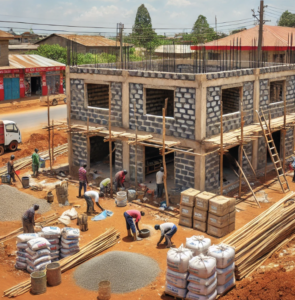
Kenya’s retail sector is moving fast, with store footprints expanding, supply chains getting tighter, and customer expectations pushing retailers to build smarter, more reliable operations. In that environment, a Kenya concrete batch plant can win big by partnering with a retail chain, not as a one-off vendor, but as a strategic construction and infrastructure ally that helps the retailer grow smoothly, protect timelines, and control long-term costs. 🏗️
A retail chain lives and dies by consistency. New stores, remodels, parking expansions, loading bays, distribution sites, and maintenance work all depend on dependable materials delivered on time. A concrete batch plant lives and dies by volume, planning, and logistics efficiency. When those two realities meet in a structured partnership, both sides get stronger.
Retail expansion depends on predictable construction timelines
Retail chains do not expand casually. Every new location, refurbishment, or format change is tied to revenue targets, lease milestones, promotional calendars, and operational staffing. When a build runs late, the retailer does not only lose time. They lose momentum, marketing dollars, and sometimes the best seasonal sales windows.
A partnership with a local batch plant adds stability to that schedule. Instead of sourcing concrete job-by-job, the retail chain gains a consistent production partner who can plan capacity around store rollouts, allocate plant time for high-priority pours, and coordinate delivery windows that fit real site conditions. This is especially valuable when multiple sites are running at once, which is common during aggressive retail expansion cycles covered daily across industry news outlets like Reuters’ retail and consumer coverage. Reuters Retail and Consumer Reuters
Supply chain resilience is now a retail priority
Modern retail is not just shelves and storefronts. It is logistics, inventory turns, transport efficiency, and risk management. Retail news has increasingly focused on supply chain resilience and operational reliability because disruptions ripple straight into customer experience and profitability. Retailers are building distribution nodes, upgrading loading areas, and investing in facilities that reduce downtime.
A Kenya concrete batch plant that partners with a chain becomes part of that resilience strategy. The plant can support rapid repairs to yards and loading aprons, pour reinforced slabs for high-traffic staging areas, and deliver consistent mixes for specialized requirements. This matters even more when retail chains shift formats, add fulfillment functions, or expand regional distribution, trends frequently analyzed in retail trade and industry coverage like the Financial Times retail and consumer reporting. Financial Times Retail & Consumer Financial Times
Retail sites need durable concrete built for heavy traffic
Retail chains put concrete under real pressure. Delivery trucks, pallet jacks, forklifts, customer vehicles, trolley traffic, and constant footfall all punish slabs, drive lanes, and loading docks. Poor-quality concrete or rushed finishing shows up quickly as cracking, spalling, drainage problems, and unsafe surfaces.
A long-term partnership allows the batch plant to learn the retailer’s standards and design mixes that match real usage. That includes consistent compressive strength, abrasion resistance, workability that suits site constraints, and curing approaches that reduce early-age issues. The result is fewer repairs, less disruption, and a better-looking site that stays safer for customers and staff.
Retailers talk openly about operational efficiency and risk reduction through organizations like the National Retail Federation, which regularly publishes updates and industry-facing announcements. NRF Press Releases National Retail Federation
Speed and coordination improve when both sides plan together
The difference between a transactional supplier and a partner is planning. With a partnership, the retailer can share a rollout calendar, and the batch plant can align production schedules, aggregate procurement, fleet allocation, and contingency planning around it.
That coordination reduces the chaos that often hits active construction sites, especially in urban areas where access is limited and timing matters. It also supports better outcomes during peak building periods when multiple contractors compete for materials and deliveries. A retail chain that secures dependable supply reduces the risk of project delays and cost overruns, and the batch plant reduces idle time by forecasting demand more accurately.
Retail industry publications that track operational trends, technology, and logistics pressures often highlight how execution discipline separates winners from the rest, including outlets like Retail Dive. Retail Dive Retail Dive
A partnership can unlock standardized store formats and quality control
Retail chains thrive on standardization. The more consistent the store format, the faster they can replicate it, train teams, and maintain brand experience. Concrete is part of that standardization, from slab thickness and joint layout to curb geometry, ramp slopes, drainage channels, and exterior walkways.
When a Kenya batch plant becomes a preferred partner, it can help the chain maintain consistent concrete performance across multiple sites. That consistency reduces rework, lowers maintenance costs, and makes contractor performance more predictable because crews are working with familiar mixes and placement expectations.
Standardization also allows better sustainability planning, including optimized mix designs that reduce waste, improve durability, and cut lifecycle costs. It is not about trendy claims. It is about building sites that last longer and need fewer disruptive repairs.
Retail distribution and grocery formats create recurring concrete demand
Retail is not one category. Grocery, convenience, big-box, specialty, and hybrid formats each have different facility needs. Grocery chains and food retail, for example, place intense demands on loading areas, yard paving, cold-chain facility construction, and frequent maintenance because heavy vehicles and strict hygiene standards drive constant upgrades.
That creates recurring demand for concrete beyond the initial build. A partnership lets the batch plant participate in expansions, add-on structures, repairs, and new distribution capacity as the retail chain scales. Grocery-focused retail news and operations shifts are tracked closely by specialized outlets like Grocery Dive. Grocery Dive Grocery Dive
Better budgeting and cost control benefit both parties
Retail chains plan capital expenditures carefully. A batch plant also needs predictable cash flow and volume to run efficiently. A partnership can include predictable pricing frameworks, volume commitments, and service-level expectations that reduce surprises for both sides.
For the retailer, that means clearer budgeting for new store builds and maintenance cycles. For the batch plant, that means better forecasting, smoother staffing, smarter fleet scheduling, and improved procurement planning. Even modest operational improvements become meaningful when repeated across multiple sites and multiple years.
This also encourages professional performance standards. When the relationship is long-term, both parties have incentives to solve problems quickly, document requirements clearly, and keep quality high, because the next project is already on the horizon.
Co-branding and community presence can strengthen reputation
Retail chains care about community reputation. Construction impacts communities through noise, traffic, and site disruption, but also through improved access, jobs, and better infrastructure. A local batch plant that supports clean, organized, on-time builds becomes part of the retailer’s local credibility.
The partnership can also support community initiatives like small infrastructure upgrades around store locations, safer pedestrian paths, improved drainage solutions, and clean site handovers that protect neighborhoods from long-term construction mess. Those practical details matter to local stakeholders and local regulators.
Clearer alignment comes from shared language and shared goals
At the simplest level, a retail chain sells trust. Customers expect availability, cleanliness, safety, and consistency. A concrete batch plant sells reliability, performance, and delivery discipline. When both sides align under a partnership, the results show up in operational stability and physical assets that hold up under real use.
A retailer that keeps expanding across Kenya will keep building. A batch plant that wants stable growth needs dependable, repeat demand. Partnering formalizes the relationship and makes that growth more profitable, less stressful, and far more predictable.
For foundational context on the retail industry itself, a neutral reference point can be useful for internal alignment across teams. Retail on Wikipedia
Conclusion
A Kenya concrete batch plant should partner with a retail chain because retail growth is built on concrete realities, including timelines, durability, logistics, and consistency. A structured partnership turns concrete supply into a strategic advantage that supports faster expansion, stronger sites, fewer repairs, and better long-term cost control. It also gives the batch plant predictable volume, improved planning, and a position inside a fast-moving industry that rewards reliable execution. 🤝